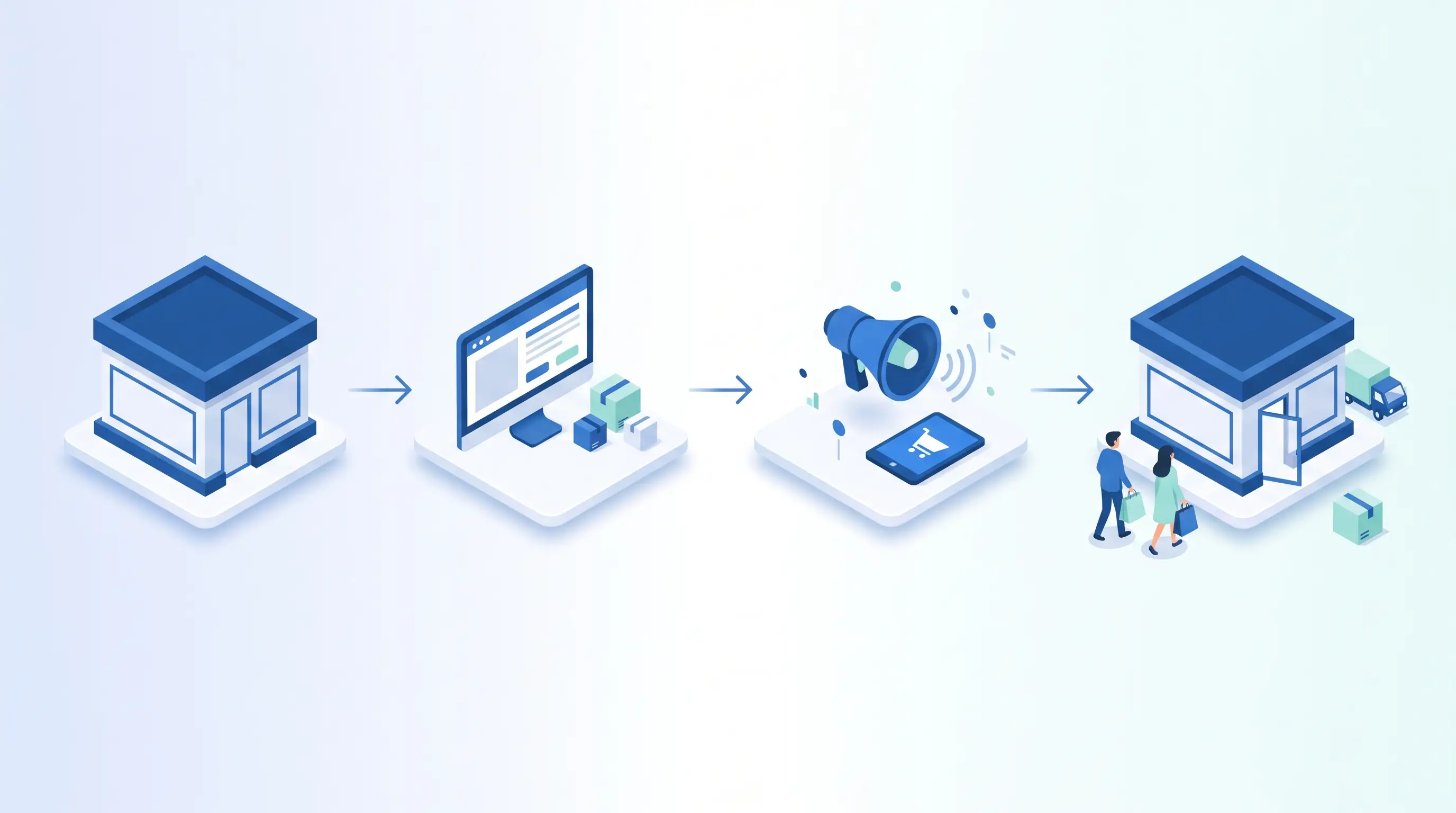

Yes, Shopify can be used in Turkey; there are no legal or technical barriers to opening a store, making sales, or earning money. However, because Shopify's own payment system, Shopify Payments, is not active in Turkey, you'll need to accept payments through local virtual POS (payment gateway) providers such as iyzico and PayTR, pay your subscription in foreign currency, and plan your tax setup in accordance with Turkish regulations. In short, the answer is "yes, it can be used" — but not "out of the box": it requires a Turkey-specific setup.
So what does this setup look like in practice? In this guide we cover, one by one, every topic a business owner wanting to open a Shopify store from Turkey will encounter: payment infrastructure and commissions, subscription costs and exchange rate risk, VAT and company requirements, shipping integrations, and TL and Turkish theme support. At the end of the article, we also honestly compare the question every e-commerce beginner in Turkey eventually asks: Shopify, or a domestic platform like ikas?
Short Answer: Yes, It Can Be Used — But Requires a Turkey-Specific Setup
Let's first clear up the rumor floating around: Shopify is not banned or blocked in Turkey. You can purchase a Shopify subscription from Turkey, manage your store from Turkey, and sell in TL to customers in Turkey. The source of the "Shopify can't be used in Turkey" perception is that some of the platform's built-in features are not active in our country — the most important of which is Shopify's own payment system, Shopify Payments.
The main points where using Shopify from Turkey diverges from a standard setup are:
- Payments: No Shopify Payments; you must connect one of the local payment providers — iyzico, PayTR, Craftgate, etc.
- Subscription: The monthly fee is charged in USD; exchange rate movements hit your budget directly.
- Tax: Your sales are subject to Turkish regulations; you need to plan your company registration, VAT, and e-document obligations from the outset.
- Shipping: Carriers such as Yurtiçi Kargo, Aras Kargo, and MNG Kargo connect via integration apps, not natively.
- Language and currency: The storefront can be in Turkish and TL, but theme translation and localization are your responsibility.
None of these items is insurmountable; each one has well-established solutions. The most common mistake we see in the businesses we work with is thinking about these topics after the store is already open. A store with an ad budget ready to go but unable to collect payments because it's still waiting for payment provider approval is far more common than you'd think. If you want to see the full setup process from scratch, check out our step-by-step Shopify store opening guide; in this article we focus on the Turkey-specific decisions.
Shopify Payments Is Not Available in Turkey: What Does This Mean?
Shopify Payments is the platform's built-in payment system. In the US, Canada, the UK, and many European countries, stores accept credit card payments directly through Shopify without needing a separate provider. Turkey is not on that list, and as of 2026 there is no official announcement that it will be added in the near term. On top of that, PayPal does not operate in Turkey either, so that avenue is also closed; the solution runs entirely through local payment institutions.
This has three practical consequences:
- A third-party payment provider is mandatory. No matter how beautiful your store is, you cannot collect a single card payment without signing a virtual POS agreement with a Turkish payment institution. The application, documentation, and approval process typically takes anywhere from a few business days to a few weeks; build this time into your opening timeline from the start.
- An additional transaction fee. Shopify charges stores that don't use its own payment system an additional transaction fee that varies by plan — generally between 0.5% and 2%. This fee is added on top of your payment provider's commission, meaning there are two separate deductions on every sale.
- Accelerated checkout options like Shop Pay are disabled. Shopify's one-click checkout experience is tied to Shopify Payments. In Turkey, customers use the standard virtual POS flow (card details + 3D Secure); with the right checkout configuration this stops being a problem, but it is one step behind the default experience.
These three items are the main factors that raise Shopify's total cost and setup effort in Turkey compared to domestic alternatives. None of them means "can't be used," however — it simply means you need to do the math with these items in mind.
Payment Providers That Work with Shopify in Turkey
The good news is that most of Turkey's leading payment institutions have Shopify integrations. To connect a virtual POS to your store, you'll typically work with one of these providers:
- iyzico — One of the most widely used providers in Shopify stores in Turkey. Quick to set up, mature documentation; installment and refund management runs comfortably through the dashboard.
- PayTR — Stands out for its SME-friendly application process and competitive commission structure; a popular choice for small and medium-sized stores.
- Craftgate — Offers payment orchestration for scaled stores that want to manage multiple bank POS terminals and payment institutions through a single integration.
- Other institutions such as Sipay, Param, and PayU — Worth getting quotes from depending on your sector and revenue profile; commission rates and integration quality vary from provider to provider.

The flow is similar across all providers: you apply to the payment institution (tax registration and company details required), and after approval you enter the API keys they give you into the corresponding Shopify app, and your payment page becomes active. Your customer enters card details with 3D Secure verification; the payment is collected in TL at the payment institution and transferred to your bank account the next day or at agreed intervals.
On the commission side, there is no single correct figure: in the Turkish market in 2026, the broadly accepted range for single-installment transactions is roughly 1.5% to 3.5%; for installment sales the rate rises with the number of installments. Revenue commitment, sector risk profile, and your bargaining power significantly affect the rate. To see providers side by side in terms of commission, settlement timeline, and installment support, check our 2026 virtual POS commission comparison.
Tax and Company Side: VAT, E-Documents, and Reverse-Charge VAT
The fact that Shopify is a foreign-based company doesn't exempt you from your tax obligations in Turkey; if anything, it adds a couple of extra items to standard e-commerce. We recommend planning this part with your accountant before the store opens.
- A registered company is required. Payment institutions require a tax registration certificate for virtual POS agreements — meaning operating a Shopify store without a company is not practically possible. A sole proprietorship is sufficient for most new entrepreneurs; transitioning to a limited liability company is planned as revenue grows and the ownership structure changes.
- VAT varies by product category. Establish the VAT rate for the products you sell upfront, configure your pricing to be VAT-inclusive, and build your profit calculations around that.
- E-invoice / e-archive. For taxpayers selling over the internet, e-document obligations kick in at lower revenue thresholds than for conventional trade; ask your accountant for the current thresholds. E-document generation is not built into Shopify: third-party apps that connect to Turkish e-invoice integrators, or bridges that push order data to your accounting software, are used instead.
- Reverse-charge VAT. The most commonly overlooked item: Shopify subscription, theme, and app payments count as services purchased from abroad, which triggers reverse-charge VAT (VAT Return No. 2). The amounts seem small and are often ignored, but failing to declare a regular expense creates headaches down the road. The withholding tax dimension can also vary by situation, so be sure to report these payments to your accountant.
- Legal texts. The distance selling agreement, preliminary information form, KVKK disclosure text, and cookie policy must be in Turkish and compliant with Turkish law. The English-language templates Shopify auto-generates are not adequate for Turkey; have the texts prepared according to Turkish law.
Practical rule: Record every dollar you pay to Shopify, themes, and apps as an expense and have your accountant flag it as "foreign digital service purchase." You'll both close off the tax risk and see your store's actual profitability.
Shipping: Desi, Integration, and the Cash-on-Delivery Reality
Shopify has no direct, built-in agreement with Turkish shipping carriers. To work with Yurtiçi Kargo, Aras Kargo, MNG Kargo, Sürat, PTT, or HepsiJET, you install one of the shipping integration apps from the Shopify App Store. These apps automatically pull orders, generate shipping barcodes, and relay tracking numbers to your customers. Key points to watch for in Turkish operations:
- Desi calculation: In Turkey, shipping costs are calculated based on desi (volumetric weight). Shopify's default shipping rules are weight-based; you'll need to incorporate the desi logic into your pricing rules yourself and run tests for bulky products to guard against surprise costs.
- Negotiated rates are your responsibility: The integration app is only the technical bridge; you negotiate the pricing agreement with the carrier. Your bargaining power increases noticeably as your monthly shipment volume grows.
- Cash on delivery: A meaningful segment of customers in Turkey still prefers cash on delivery. You can define this as a manual payment method in Shopify and handle collection through the carrier; factor in that carriers charge a separate collection commission for this service.
- Returns process: Due to the 14-day right of withdrawal under distance selling regulations, define your return shipping flow (who pays, which carrier, which address) upfront; stores with a poor returns experience pay for it heavily in reviews.
If you're considering international sales, the picture changes: pair logistics companies that ship under micro-export (ETGB) with Shopify's multi-market features and the platform offers a serious advantage. Shopify's global side is one of the areas where it outshines domestic alternatives the most.
TL, Turkish Themes, and Localization
You can set your store currency to TL, list your products at TL prices, and collect payments in TL; there's no restriction there. On the language side, there are two separate layers: the storefront your customers see and the admin panel you use.
On the storefront side, themes are open to translation: the default text in pre-built themes is localized to Turkish through language files, and product and page content you enter in Turkish anyway. However, if you don't go through every string — from the "Add to Cart" button to shipping notification emails — you'll end up with a store that's half English, half Turkish. This is one of the most common issues we fix in the Shopify stores we take over. Whether to go with a pre-built theme or invest in a custom design is also a decision that needs to be made at this point; we worked through the criteria for that decision in detail in our pre-built theme vs. custom design comparison.
The admin panel and official documentation are primarily in English; having at least one person on the team who is comfortable with basic English significantly speeds things up. On the SEO side, Shopify's infrastructure works seamlessly with Turkish content: it's up to you to structure your product and category pages around Turkish search behavior. We've covered how to do that step by step in our e-commerce SEO guide.
Shopify Turkey Total Cost (2026): A Line-by-Line Breakdown
Shopify's real cost in Turkey is not limited to the monthly subscription fee. When making your decision, you need to look at the sum of the following items:
- Subscription: The entry-level plan runs in the 25–40 USD/month range (more advantageous on annual billing); higher plans for growing stores are significantly more expensive. Since the fee is charged in foreign currency, exchange rate movements directly affect your TL budget.
- Theme: You can start with free themes; quality paid themes are a one-time investment of roughly 100–400 USD.
- Apps: Between the shipping integration, e-invoice bridge, Turkish localization tools, and marketing apps, a typical app expense of 20–100 USD/month is common; this line item quietly grows as the number of apps increases.
- Payment commission: Consider your payment provider's commission and Shopify's third-party transaction fee together; combined, they make up the actual percentage deducted from your revenue on every sale.
- Setup and design: If you do it yourself, the cost is your time. Professional Shopify setup in the 2026 Turkish market ranges from a simple launch to a comprehensive custom design, roughly from 15,000 TL to several hundred thousand TL; it varies based on scope, number of products, and integration needs.

When you add it all up, a two-tier cost structure emerges for a small store: "monthly fixed costs + a percentage of revenue." This structure grows in TL terms as the exchange rate rises; with domestic platforms, the subscription is in TL so predictability is higher. We analyzed the full e-commerce launch budget — infrastructure, design, advertising, and operations — line by line in our how much does it cost to open an e-commerce site article. If you'd like a scope-based, concrete figure for your own project, our free analysis wizard will generate a tailored quote in a few minutes.
Shopify vs. a Domestic Platform (ikas)?
This is the question everyone starting e-commerce from Turkey eventually arrives at. Both sides have genuine strengths; the right answer depends on your business goals. Let's first look at the comparison table:
| Criterion | Shopify | ikas |
|---|---|---|
| Subscription currency | USD (exposed to exchange rate risk) | TL (predictable budget) |
| Local payments | Via app (iyzico, PayTR, etc.) + additional transaction fee by plan | Built-in; no additional platform commission on plans |
| Trendyol / Hepsiburada | Via third-party apps | Built-in marketplace integration |
| E-invoice | Via third-party bridges | Ready-made integrations |
| Theme and app ecosystem | Very broad — thousands of options on a global scale | Narrower but focused on Turkey's needs |
| International sales | Very strong: multi-language, multi-currency | Developing; main focus is the Turkish market |
| Support | Primarily in English, very large community | Turkish-language support |
To summarize broadly: if most of your sales will be in Turkey, you'll be working closely with marketplaces, and you want to keep all your costs predictable in TL, a domestic platform generally offers a less friction-heavy start. If international sales, a niche branding objective, or specific apps in the Shopify ecosystem are on the table, Shopify's flexibility closes the gap and pulls ahead. We compared every dimension of this decision — price, features, support, growth scenarios — in depth in our ikas vs. Shopify article.
Who Is Shopify Right For, and Who Is It Not?
Let us honestly summarize what we see in the accounts we manage. The platform decision is not a matter of allegiance — it's an output of your business profile.
Shopify may be the right choice for you, if:
- International sales (e-export) are part of your short- or medium-term plan,
- You want a broad theme and app ecosystem to deliver a shopping experience unique to your brand,
- Paying your subscription and app costs in foreign currency doesn't strain your budget,
- There is at least one person on the team who can work with an English-language panel and documentation.
A domestic platform is probably more sensible, if:
- Nearly all your sales will be in Turkey and you'll be working closely with marketplaces,
- You don't want exchange rate exposure and want all expenses visible in TL,
- You want to handle e-invoicing, shipping, and payments in a single panel with Turkish-language support.
In either case, what determines success is not the platform itself but the quality of the setup: the smoothness of the payment flow, page speed, the strength of your product content, and conversion-focused design. A poorly configured Shopify store and a poorly configured domestic platform store both sell equally poorly.
Getting Started with Shopify from Turkey: A Step-by-Step Roadmap
Let's put everything we've covered into an actionable sequence. Running through the steps in this order when opening a Shopify store from Turkey prevents you from sitting idle while waiting for payment approval and from hitting surprise roadblocks on launch day:
- Clarify your company and tax structure. Discuss with your accountant — sole proprietorship or limited company, VAT rates, e-document obligations — before you add a single product to the store.
- Apply to a payment institution immediately. Approval is usually the longest wait item; run the application in parallel with the store setup so that when the design is done, payments are ready too.
- Open your Shopify subscription and choose your theme. Use the trial period to establish your theme and product structure; upgrade to a higher plan when there's a genuine need.
- Localize the theme end-to-end into Turkish. Check not just the storefront text but also order confirmation, shipping notification, and returns emails; half-finished translations undermine customer trust.
- Have your legal texts prepared under Turkish law. Don't run ads before a distance selling agreement, preliminary information form, KVKK disclosure text, and cookie policy are all live.
- Set up the shipping integration and test it with desi. Configure test shipments for your lightest and most voluminous product to confirm your shipping costs align with your pricing.
- Connect the e-invoice bridge. Issue a test document for a test order to verify the accounting flow before launch.
- Place a real test order with your own card. Walk through the 3D Secure flow, installment options, and the returns process on your own card end-to-end; friction on the payment page is the quietest enemy of your ad budget.
- Set up measurement before launch. Have GA4, Meta Pixel, and Google Ads conversion tracking collecting data from day one; the first weeks without measurement are gone forever.
Setting up Shopify for Turkey's conditions — the right payment provider, e-document bridge, shipping integration, Turkish localization, and conversion-focused design — is solvable piece by piece, but it's time-consuming. As Alis Dijital, our Shopify store setup service takes care of all these steps on your behalf, delivering a sales-ready store. If you'd like to discuss your project, we're just a message away.