Most e-commerce businesses in Turkey spend nearly their entire budget chasing a single question: "How do I find new customers?" As advertising costs rise year after year, the most valuable asset often goes unnoticed: customers who have already bought from you at least once. Selling again to an existing customer is many times cheaper, faster, and more profitable than acquiring a new one. What's more, these customers already know your brand, they trust it, and with the right approach they'll keep buying from you for years.
In this guide we explain why customer loyalty is the hidden engine of growth, which metrics to track and how to calculate them, and concrete methods ranging from RFM segmentation to loyalty programs and subscription models — all presented in a way that's practical for SMEs. Our goal isn't a theoretical lecture; it's to help you build a measurable retention strategy you can start applying in your store today.
Why Are Existing Customers More Profitable Than New Ones?
When people talk about "growth" in e-commerce, the first thing that comes to mind is usually acquiring new customers. Yet sustainable profit most often comes from retaining the customers you already have. There are a few clear reasons for this.
First, acquisition cost. The amount you pay in advertising to win a new customer — your customer acquisition cost (CAC) — has risen noticeably in Turkey over recent years. Once you've paid that cost and landed the customer, making the second, third, or fifth sale to that same person requires almost zero ad spend. In other words, the first sale "pays off" the acquisition cost, and the real profit comes with every sale after that.
Second, conversion rate. A customer who already knows you and left satisfied last time will purchase at a much higher rate than a brand-new visitor. A campaign sent to a warm email list typically converts many times better than cold traffic. We cover the full range of ways to lift your conversion rate in our conversion rate optimization (CRO) guide.
Third, basket size. Repeat customers generally trust you more, which makes them more willing to try higher-priced products and fill larger carts. Over time their average order values tend to exceed those of new customers.
Fourth, the referral effect. Satisfied, loyal customers recommend your brand to the people around them, generating new customer flow at zero cost to you. Loyalty isn't just about repeat sales — it's also the source of organic growth.
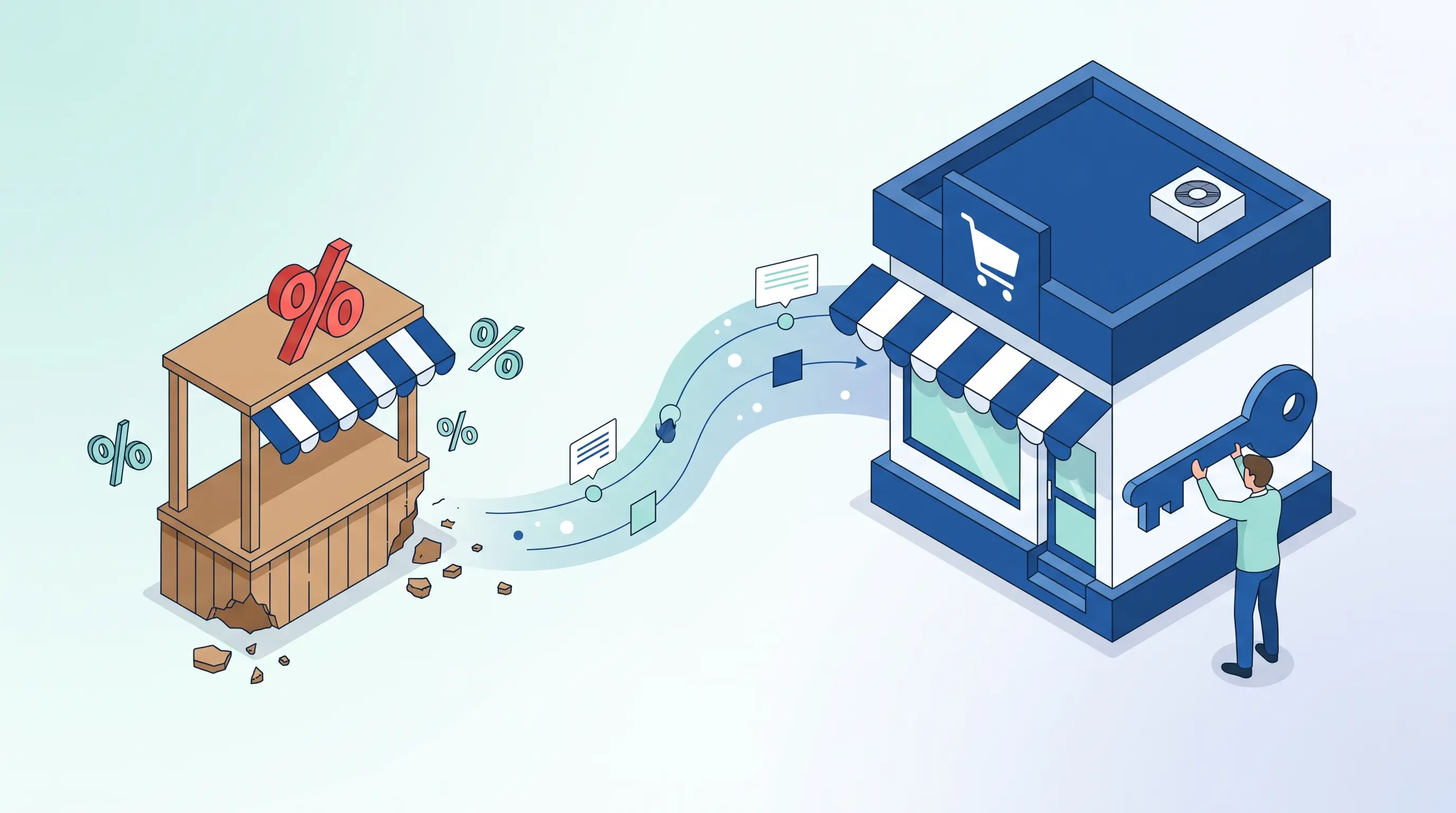
The "leaky bucket" analogy
Think of your store as a bucket full of water. Advertising is the water poured in from the top. Customer loss (churn) is the holes in the bottom of the bucket. No matter how much water you pour in, the bucket never fills if the holes aren't plugged — you constantly need more ad spend. Retention is about sealing those holes. Most businesses leave the tap fully open without ever looking at the holes; it's an unprofitable cycle that keeps repeating.
The Core Retention Metrics You Need to Know
"You can't manage what you can't measure." Before starting any loyalty work, you need to see your current situation in numbers. Here are the key metrics to track.
Repeat Purchase Rate
This is the share of customers who placed more than one order in a given period, out of all customers. It tells you whether your brand is "one-and-done" or "habit-forming."
- Formula: (Number of customers with more than one order ÷ Total number of customers) × 100
- Example: You had 1,000 unique customers in a year, and 250 of them placed more than one order. Repeat purchase rate = (250 ÷ 1,000) × 100 = 25%.
While it varies by industry, we expect this rate to climb over time for a healthy e-commerce brand. If it stays low, there's a problem with product satisfaction or post-purchase communication.
Customer Retention Rate
This measures what share of customers who were active at the start of a period are still active (still purchasing) by the end of it.
- Formula: [(Customers at end of period − New customers acquired during period) ÷ Customers at start of period] × 100
- Example: You started the year with 500 customers, gained 200 new customers during the year, and ended the year with 600 active customers. Retention rate = [(600 − 200) ÷ 500] × 100 = (400 ÷ 500) × 100 = 80%.
In other words, you retained 400 out of your original 500 customers. That means 80% retention and 20% churn.
Customer Churn Rate
Churn is the exact opposite of retention: the share of customers you lost in a given period. Churn = 100 − Retention Rate. In the example above, churn is 20%. In e-commerce, customer "loss" isn't a clear-cut cancellation; typically a person is counted as "lost" if they haven't placed any order for a set period (say, 6–12 months). You need to define that window based on your own typical purchase frequency.
Net Promoter Score (NPS)
Calculated from responses to the question: "On a scale of 0–10, how likely are you to recommend this brand to a friend?" Respondents scoring 9–10 are Promoters, 7–8 are Passives, and 0–6 are Detractors.
- Formula: NPS = (% Promoters) − (% Detractors)
- Example: Out of 100 responses, 60 scored 9–10, 25 scored 7–8, and 15 scored 0–6. NPS = 60% − 15% = +45.
NPS is a "leading indicator" of loyalty; a low NPS foreshadows future churn. You can collect it easily with a single-question survey sent automatically a few days after each order.
How to Calculate Customer Lifetime Value (CLV / LTV)
The compass for all loyalty work is Customer Lifetime Value (CLV, also written LTV). CLV is the total value an average customer generates for you over the entire course of your relationship. Without knowing this number, you can never correctly determine how much ad spend is justified to acquire a customer.
Simple CLV formula
A practical approach that works well at SME scale:
- Average Order Value (AOV) × Annual Purchase Frequency × Average Customer Lifespan (years) = Rough CLV (revenue-based)
Example (revenue-based):
- Average order value: 800 TL
- A customer buys on average 3 times per year
- Average customer lifespan: 2.5 years
- CLV = 800 × 3 × 2.5 = 6,000 TL
This is the lifetime revenue per customer. To make decisions, we need to convert it to profit.
Profit-based (net) CLV
What really matters is how much of that revenue stays in your pocket. Apply your gross profit margin:
- Let's apply a 40% gross profit margin to the 6,000 TL revenue above.
- Net CLV = 6,000 × 0.40 = 2,400 TL
Calculating the margin correctly is vital; if you ignore line items like product cost, shipping, commissions, and returns, your CLV will be a fantasy. Our profit margin calculation guide walks you through it step by step.
Connecting CLV to advertising decisions
If your net CLV is 2,400 TL, you can spend up to 2,400 TL to acquire one customer and still be profitable in the long run — as long as your cash flow can carry that payment window. In most healthy models the target is a CLV ÷ CAC ratio of at least 3: at least 3 TL of lifetime value for every 1 TL spent on acquisition. To read this ratio alongside your advertising returns, check out our article on what ROAS is and how to calculate it.
The critical insight is this: the higher your CLV, the more aggressive you can afford to be with advertising. While your competitors are looking at the profit from a single sale, if you're looking at lifetime value, you'll win the customer acquisition battle.
RFM Segmentation: Get to Know Your Customers
Sending the same message to all customers is the most common mistake in loyalty work. RFM analysis is a powerful method that groups customers by behavior and is easy to apply even for SMEs. It looks at three dimensions:
- R — Recency: When did the customer last make a purchase? More recent buyers are "warmer."
- F — Frequency: How many total purchases have they made? Frequency is the strongest signal of loyalty.
- M — Monetary: How much have they spent in total?
Score each customer on these three dimensions (for example, 1–5) and group them into meaningful segments. You can pull this data from the order reports in most store software or marketplace dashboards.
Practical segments and actions
- Champions (high R, F, M): Your most valuable, most loyal customers. Make them feel like VIPs — early access, personal thank-you gestures, exclusive touches.
- Loyal customers (high F): They buy regularly. Ideal candidates for upselling and invitations to your loyalty program.
- At-risk / dormant (low R, formerly high F): Once great customers, haven't been seen in a while. The primary target for win-back campaigns.
- New customers (high R, low F): First impressions matter. Move them toward a second purchase with a solid welcome series.
- Lost customers (low R, F, M): Don't chase them with expensive campaigns; one final low-cost win-back attempt is enough.
The power of RFM is that it directs your limited budget toward the segment with the highest return. Sending discount coupons to Champions is throwing money away — they were going to buy anyway. Put that budget toward winning back the at-risk segment instead.
Loyalty and Points Programs: Reward Repeat Buying
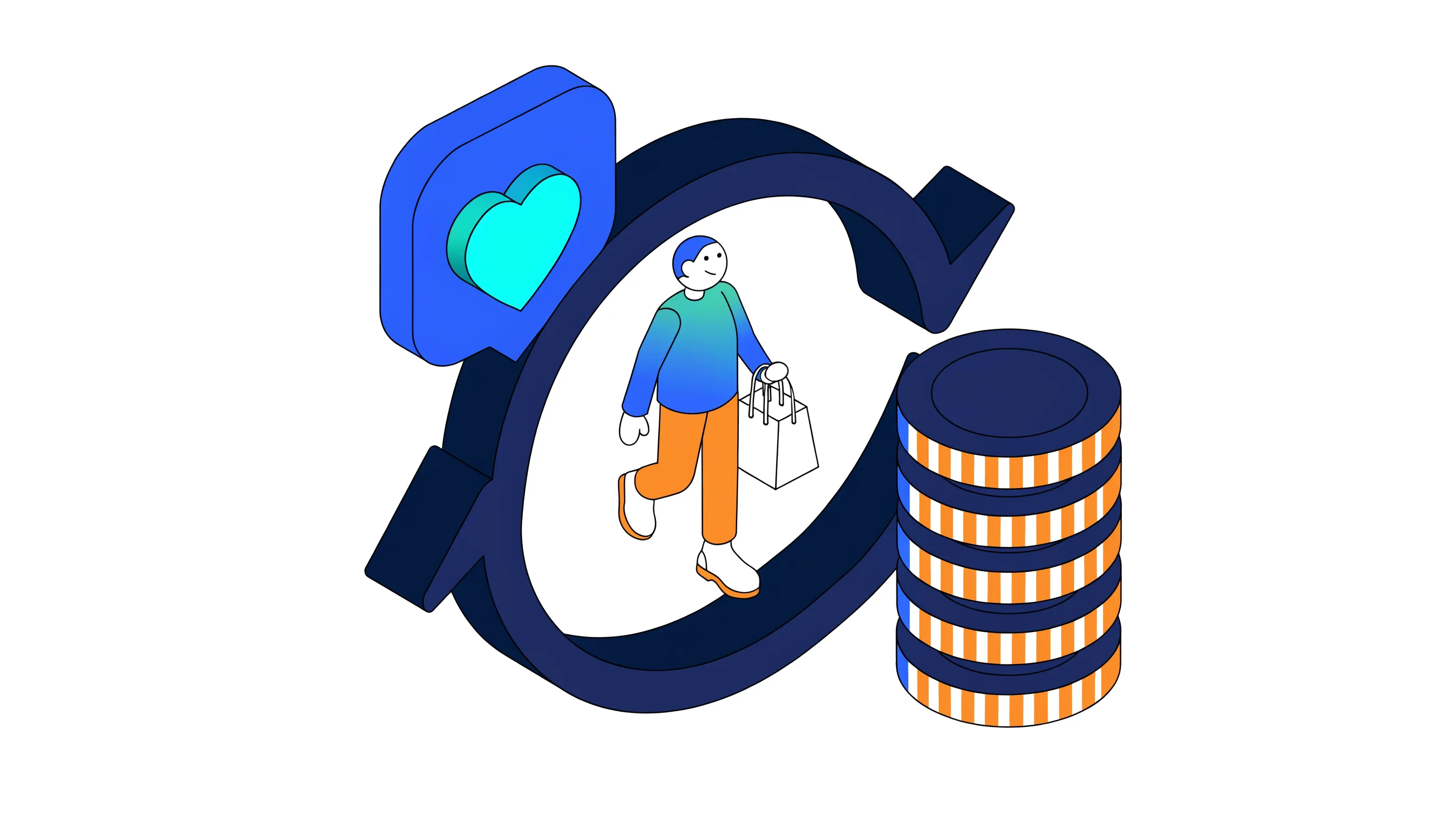
A loyalty program gives customers "a reason to come back." A well-designed program visibly increases repeat purchase rates and CLV. But a poorly designed one simply eats into your profit margin. Getting it right matters.
Common program types
- Points-based: Customers earn points with each purchase and redeem them for discounts. The most intuitive model. ("Every 1 TL spent = 1 point; 500 points = 25 TL off.")
- Tiered (level) system: Customers move through levels — Bronze, Silver, Gold — as they spend, with higher tiers offering better perks (free shipping, priority support, exclusive products). The sense of status increases frequency.
- Hybrid: Both points and tiers. Most mature brands gravitate here.
Rules for a good loyalty program
- Keep it simple: Customers should be able to understand "what do I get?" within five seconds. Complex rules kill participation.
- Reachable rewards: If the first reward feels too far away, no one starts. Give that first small reward early so motivation kicks in.
- Protect the margin: Compare the cost of rewards against the incremental repeat sales the program will drive. Always run the profit calculation.
- Non-monetary perks: Early access, exclusive content, a birthday surprise — low-cost but high-value gestures that grow loyalty without discounts.
Remember: the best loyalty is bought with experience, not discounts. Building a customer base that's addicted to deals corrodes your margin over time.
Personalization and the Post-Purchase Experience
Loyalty begins the moment the customer clicks the buy button. What turns "I wish I'd bought elsewhere" into "I'm glad I bought here" is the experience they have after the order is placed.
Personalized recommendations
Recommendations based on past purchase behavior — "you might also like these" — increase both basket size and repeat sales. If a customer bought a coffee machine, a suggestion for beans or filters a few weeks later feels completely natural. Most store platforms and email tools let you automate these recommendations.
Packaging, shipping, and delivery
- Packaging: A careful, clean, branded package turns the unboxing moment into a small celebration — and something people share on social media.
- Shipping transparency: Don't put customers through the stress of "where's my order?" Automated shipping update SMS/emails noticeably boost satisfaction.
- Small surprises: A handwritten note, a small sample, or a thank-you card can turn a customer into an active referrer.
Return and exchange policy
A bad return experience loses a customer permanently. A clear, easy, and fair return process is actually a sales tool — because when customers feel confident that "if something goes wrong I can sort it out easily," they buy with less hesitation. View returns as a trust investment, not a cost. That trust also helps complete abandoned carts; we cover how to win back cart-abandoners in our cart abandonment reduction guide.
Support and communication
Fast, genuine, solution-focused customer support is the backbone of loyalty. Resolving a problem quickly and kindly can actually build a stronger bond than if the problem never occurred at all. Keep response times short on WhatsApp, email, and live chat; even an automated "we've received your message" reply gives customers the reassurance they need.
Subscription Models, Win-Back Campaigns, and Email Automation
The two most powerful ways to systematize repeat sales: subscription models that generate predictable revenue, and win-back automations that wake up dormant customers.
Subscription / renewal models
If you sell products that are consumed on a regular cycle (coffee, vitamins, skincare, personal care, pet food), a subscription model dramatically increases CLV. Once a customer subscribes, they no longer need to make a conscious purchase decision every month; revenue becomes predictable and churn drops. Offering subscribers a small discount or free shipping is a reasonable price to pay for that steady income stream.
Win-back campaigns
Pull back the customers flagged as "at-risk" or "dormant" in your RFM analysis using automatically triggered campaigns:
- A "We miss you" message to customers inactive for a set number of days.
- A personalized recommendation or a small incentive.
- If there's no response, one stronger final offer, then rest the list.
The beauty of win-back is that you've already paid the acquisition cost for these customers; bringing them back is far cheaper than finding new ones.
Email and automation: the retention engine
At the heart of all these scenarios — welcome series, post-purchase thank-you, cross-sell suggestion, win-back — is email and messaging automation. A properly built automation handles retention even while you sleep. We've covered this closely related topic from start to finish in our email marketing and automation guide.
How Poor Retention Impacts Your Advertising Costs
If retention is weak, the problem isn't just "fewer repeat sales" — your entire advertising economics collapse. That's because poor retention eliminates any chance of recovering the acquisition cost.
Let's compare two scenarios. (Example) Both stores have a customer acquisition cost of 300 TL and a first-order profit of 200 TL.
- Store A (weak retention): Customers typically buy once and leave. Net CLV ≈ 200 TL. CLV (200) is below acquisition cost (300) → every customer is a loss. The more they scale ads, the more they lose.
- Store B (strong retention): Customers buy an average of 4 times. Net CLV ≈ 800 TL. CLV (800) ÷ CAC (300) ≈ 2.7 → every customer is profitable. With the same ad budget, B grows while A shrinks.
As you can see, the difference isn't in the product or the ads — it's in retention. Every small improvement that lifts retention (like increasing repeat sales by 20%) flows directly into your ability to sustain ad spending. That lets you absorb higher click costs than your competitors and market more aggressively.
Measure it with cohort analysis
If you're serious about retention, cohort analysis is a must. You tag customers acquired in a particular month as a "cohort" and then track what share returns in subsequent months. This reveals which cohorts are more loyal and which changes are actually working. To set up cohort and retention reports, our e-commerce Google Analytics guide is a great resource.
Conclusion
Customer loyalty isn't a luxury you can shrug off as "nice to have" — it's the foundation of sustainable e-commerce. When you shift even a portion of the energy you spend chasing new customers toward retaining existing ones, both your profitability and your advertising staying power improve. Start by measuring your metrics (repeat purchase rate, retention, churn, NPS, CLV), then segment with RFM, reward repeat buying through a loyalty program and personalization, perfect the post-purchase experience, and wake up dormant customers with win-back automations. All of this together seals the holes in the bucket and converts every drop of ad spend into profit.
Let's pull your store's real retention and CLV picture together and pinpoint which holes need to be sealed first. Start with a free e-commerce analysis, or reach out directly via our contact page — we'll look at your data and map out an actionable, tailor-made loyalty roadmap.