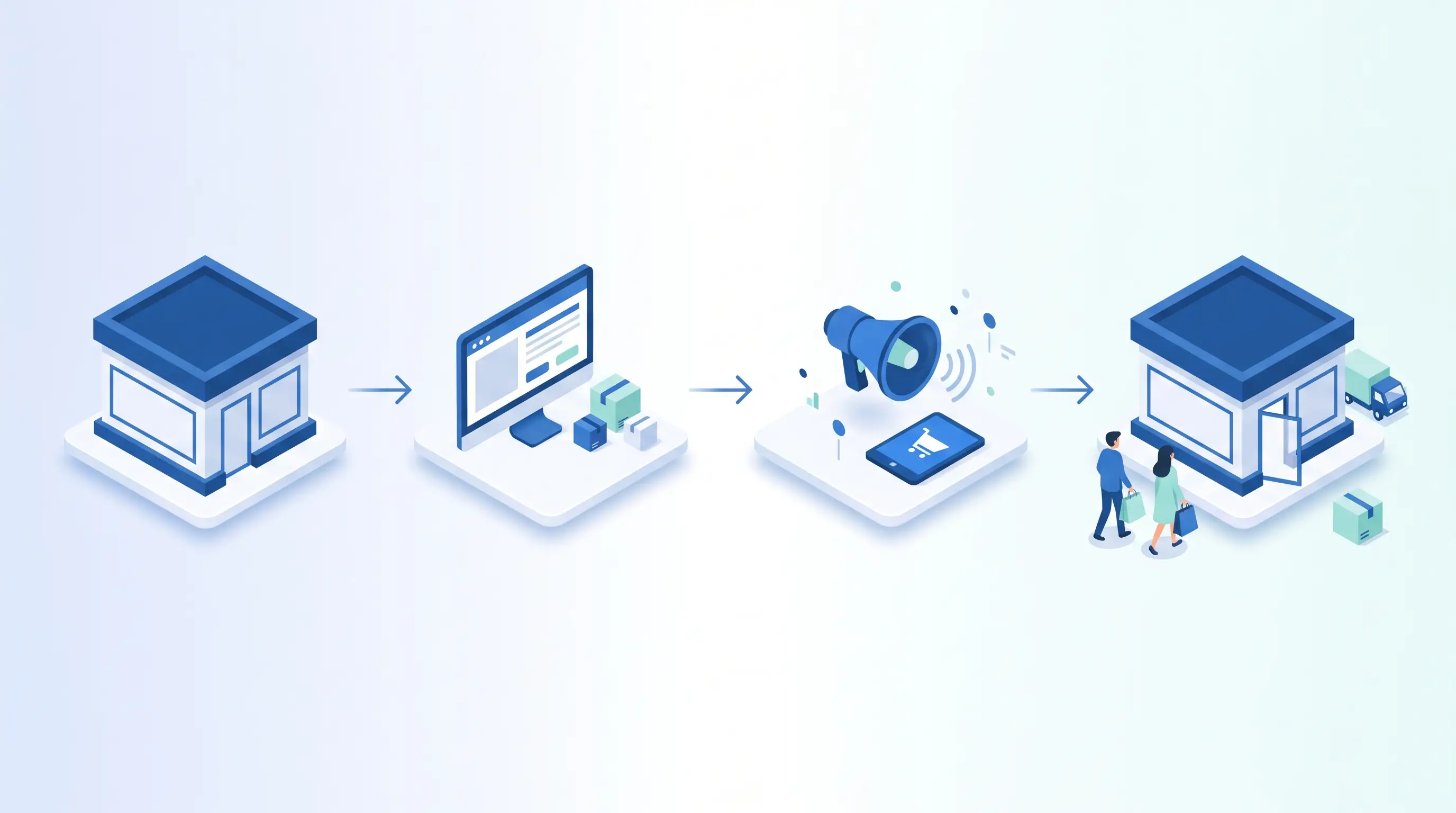

E-commerce consulting is the service that looks at every aspect of your online store — platform selection, profitability and margin structure, marketplace strategy, advertising and conversion channels, operations — through expert eyes from the outside, diagnoses problems, and produces a prioritized roadmap. The goal isn't to leave you a report; it's to clarify which work needs to be done, in what order, and why, and to make execution measurable. As of 2026, monthly consulting fees in Turkey typically range from 15,000 TL to 60,000 TL+ depending on scope, while project-based engagements start at 40,000 TL and can exceed 250,000 TL depending on scope.
In this article we want to lift the ambiguity around the word "consulting." What does it cover and what doesn't it cover; which businesses genuinely need it and which are too early; what drives pricing and how do you measure the return on what you pay? We'll address all of it — without sales gloss — using real situations we've observed across the accounts we manage.
What exactly is e-commerce consulting?
In its simplest definition: it's the external, data-driven, and experience-backed audit of your e-commerce operation, combined with the collaborative building of a growth plan. A good consultant sees what you can't see because you've been inside it for months: mispriced shipping, a commission structure that's eroding profit, a campaign setup that's consuming ad budget without generating sales, visitors who make it to the cart and then leave.
What distinguishes consulting from other services is this: in agency services, most of the work is done by the external team; in consulting, you're buying decision quality. The consultant diagnoses, produces a roadmap, coordinates execution with your team or your existing suppliers, and measures the results. That's why consulting is one of the highest-leverage expenditures — especially for businesses saying "we're doing things but we're not sure we're doing the right things."
Scope: what areas should a solid consulting engagement cover?
Package names vary from firm to firm, but a healthy e-commerce consulting engagement should examine five core areas:

1. Platform and technical foundation
Is your store on the right platform? In Turkey-focused selling, domestic and global platforms carry different trade-offs; making this decision wrong creates migration costs down the line. We covered this in detail in our ikas vs. Shopify comparison guide. The consultant also looks at site speed, mobile experience, and measurement setup (GA4, pixel, conversion events) — without measurement, no decision in a store can be made on solid footing.
2. Profitability and unit economics
It's profit, not revenue, that you grow. Product cost, shipping, commission, advertising, returns, and operational expenses are laid out one by one; break-even by product is calculated. Running an ad budget without knowing your break-even ROAS is like driving in the dark. The most common picture we see in the businesses we work with is a store whose revenue is growing while its profit is shrinking; we covered the levers in our profit-focused growth guide.
3. Channel strategy: marketplaces and your own site
Trendyol and Hepsiburada bring volume, but commissions and price competition compress margins; your own site preserves margins, but you have to earn the traffic yourself. The right answer is usually a balanced blend of both — and that blend varies by industry, product, and capital. The consultant builds a transition plan that positions the marketplace as a cash-flow engine and your own site as a brand and profit engine.
4. Marketing coordination
Ads, SEO, email marketing, and social media should work not as separate channels but as a single system. The consultant's role isn't to manage every channel personally; it's to establish budget and priority allocation across channels, to combine conversion rate optimization with ad efficiency, and to consolidate reporting into a single dashboard.
5. Operations and customer experience
Shipping time, the returns process, inventory management, e-invoice integration, and GDPR/data-privacy compliance shape the post-purchase experience — and are the foundation of repeat purchases. What happens after the cart abandonment typically costs more in revenue than advertising does in most stores. A simple example: a shipping agreement with incorrect desi (volumetric weight) calculations silently erodes profit across hundreds of orders; a slow returns process comes back as negative reviews — raising your effective advertising costs.
Covering all five areas together matters, because problems in e-commerce rarely travel alone: when conversion rate is low, the cause is sometimes the ad audience, sometimes site speed, sometimes the shipping cost disclosed too late in the cart. An eye that looks at only one channel writes the wrong prescription. An eye that knows the real cost items of e-commerce doesn't confuse where to save with where to invest.
Who needs it, and who doesn't?
Let's be honest: consulting isn't the right spend for every business.
- Needs it: Stores with steady monthly sales whose growth has stalled; businesses that are spending on ads but can't clearly see their profit; those wanting to move from marketplaces to their own site; teams that have the people but lack strategic direction.
- Too early: Early-stage startups with a few orders a month whose product and market aren't yet defined. At this stage, the budget priority is product-market fit and basic setup; our guide to common starting mistakes will deliver more value than consulting at this point.
- Wrong expectation: "Let the consultant come in and double our sales in a month" isn't realistic. Consulting isn't magic — it's systematic improvement; its effect typically becomes measurable from month 2–3 onward.
Let's think through a concrete scenario: a home textiles brand with 800 monthly orders whose revenue is rising while its bank account isn't growing. The typical diagnostic picture looks like this: campaign prices set without accounting for marketplace commission and return costs; ad campaigns running below break-even ROAS; and a checkout issue on the brand's own site that no one has noticed because it isn't being measured. Each of these looks small in isolation; together they're often a profit leak worth several times the monthly consulting fee. That's exactly what consulting does: make scattered small leaks visible in a single table and set the order in which they get fixed.
Types of consulting: which one addresses your problem?
"E-commerce consulting" isn't a single uniform service; it comes through different specialist lenses depending on the need. Clarifying which type you're discussing when getting quotes sets both the price and the expectations correctly:
- General e-commerce consulting: The main subject of this article; looks at the whole operation, sets priorities, coordinates execution. The right door for stores that have lost direction or whose growth has stalled.
- Performance/marketing-focused consulting: Focuses on improving ad accounts, the funnel, and conversion rate. Suited to businesses whose operations are solid but whose advertising is inefficient.
- Platform and migration consulting: Well-scoped technical projects such as platform selection, data migration, and transition planning without SEO loss. Typically priced on a project basis.
- Marketplace consulting: Listing quality, buybox, campaign, and commission optimization on Trendyol/Hepsiburada. A separate area of expertise for marketplace-heavy sellers.
- Export consulting: For those targeting international sales — market selection, payment and shipping setup, and regulatory framework. Micro-export processes contain their own specific details.
A small tip: if your need is in a single area (say, ad performance only), taking focused consulting rather than a broad package protects your budget; but if the problem spans multiple areas, buying services piecemeal turns into a puzzle where no one sees the whole picture.
Consultant, agency, or in-house team?
These three aren't rivals — they're answers to different needs. We covered the decision in detail in our agency vs. in-house team guide; the summary table is:
| Model | What you buy | When it makes sense |
|---|---|---|
| Consulting | Diagnosis + roadmap + decision quality | When direction is unclear and team/suppliers exist |
| Agency | Execution power (ads, content, design) | When there's no in-house capacity to execute |
| In-house team | Full control and brand focus | When volume has grown and continuity is needed |
In practice, the most frequently effective model is a hybrid: strategy and oversight from the consultant, execution from the agency or in-house. What matters isn't the label — it's that responsibilities and success metrics are written down from the start.
2026 Turkey pricing: realistic ranges
Pricing varies by scope, the business's revenue, number of channels, and the consultant's experience. There's no single right price, but the broadly accepted ranges in the 2026 Turkish market are roughly as follows:
| Engagement model | Typical range (2026) | Best suited for |
|---|---|---|
| One-time audit/analysis | 15,000 - 60,000 TL | Snapshot of current state + priority list |
| Monthly retainer | 15,000 - 60,000 TL+/month | Ongoing guidance, monthly target tracking |
| Project-based (e.g. platform migration, channel setup) | 40,000 - 250,000 TL+ | Well-scoped transformation projects |
| Hourly session | 2,000 - 6,000 TL/hour | Targeted questions, second opinion |
Read these figures as a negotiating baseline, not a commitment: as scope narrows you approach the lower bound; as revenue and channel complexity grow you approach the upper bound. Very low offers typically come with off-the-shelf template reports; very high ones typically include scope you don't need. If you'd like to see an itemized quote tailored to your business, our free analysis wizard provides a clear framework in a few minutes.
What drives the price? 6 factors
The fact that the same service is priced differently for two businesses isn't arbitrary — the variables that make up the price are well-defined:
- Revenue and order volume: As the amount of data, products, and scenarios to review grows, so does the analytical effort. Auditing a 100-order-per-month store and a 10,000-order-per-month store are not the same job.
- Channel complexity: A brand that only has its own site versus one with three marketplaces, a dealer network, and export targets requires a roadmap of very different depth.
- Scope breadth: Ad performance only, or end-to-end from platform to operations? As scope narrows, price moves to the lower band.
- Meeting frequency and accessibility: A single monthly report meeting versus a weekly cadence with instant availability are not the same level of engagement.
- Experience and references: A consultant who can show measured results in your sector naturally commands a higher rate per hour.
- Contract length: On 6–12 month commitments, the monthly fee is typically structured more reasonably than on short-term engagements.
When comparing quotes, look not just at the number but at how these six items are addressed in the proposal; both the most expensive and the cheapest quote is the wrong one if it doesn't match your needs.
How does the process work? The first 90 days

A healthy consulting engagement typically advances in four steps:
- Analysis (1–3 weeks): Data access is established; sales, advertising, site, and operational data are reviewed. Output: findings and a prioritized problem list.
- Roadmap (1 week): Which task, in what order, by whom, toward which goal? Every item is tied to a measurable metric.
- Execution support (ongoing): Weekly/bi-weekly progress tracking; supplier and team coordination; unblocking stalled tasks.
- Reporting and revision (monthly): Target vs. actual comparison; honest closing of hypotheses that didn't work, scaling of those that did.
At the end of the first 90 days you should have at minimum: a clean measurement setup, a product-level profitability table, channel priorities, and a functioning monthly cadence. If those aren't there, question the process.
7 questions for choosing the right consultant
- Which businesses similar to mine have you worked with, and what results were measured?
- What specific deliverables will you hand over in the first month?
- What metrics will we use to measure success — revenue, profit, or CAC?
- Who will do the execution, and where does your role end?
- Do you receive commissions from ad platforms, infrastructure providers, or shipping carriers? (Conflict-of-interest test)
- What data will you need access to, and how will you protect it (data privacy regulations)?
- How are exit conditions and knowledge handover handled in the contract?
Every question you can't get a clear answer to is a red flag. Also stay away from any consultant who says "we guarantee sales" — no serious professional gives guarantees for variables outside their control.
Your side of the equation: getting the most out of consulting
Consulting isn't a one-sided transaction; the yield of the process depends heavily on the business's involvement. The common traits of the businesses that get results fastest in our collaborations are:
- They share data openly: A business that shares costs with real figures — not "roughly" — gets an accurate diagnosis. Incomplete data means the wrong prescription.
- They designate one decision-maker: Roadmaps move quickly in businesses where decisions are concentrated in one person; in structures where everyone has a say, work dissolves in meetings.
- They don't let small tasks wait: The "quick wins" in the roadmap — raising the free-shipping threshold, updating product titles, adding a payment option — are usually one-week tasks; if they sit for months, the consulting engagement loses momentum.
- They embrace a hypothesis culture: Not every recommendation sticks; what matters is measuring what didn't stick quickly and shifting budget toward what did.
5 common consulting mistakes
- Not putting the scope in writing: An engagement that starts with "we'll look at everything" turns into one where no one is accountable. Scope, deliverables, and metrics must be spelled out item by item in the contract.
- Mistaking the report for the result: A 40-page analysis is a PDF until it's implemented. Clarify upfront whether the proposal includes "post-analysis execution support."
- Expecting everything in three months: Measurement and quick wins show up early; structural transformation (channel shifts, profitability repair) plays out over time. Impatience is the most common reason a correctly functioning process gets cut short.
- Putting the consultant in the team's place: The consultant sets direction; expecting them to run daily operations makes costs inefficient and blurs roles.
- Not questioning impartiality: A recommendation from a consultant who receives a commission from the infrastructure or agency they recommend should not be accepted without passing it through a conflict-of-interest filter — asking directly is your right.
How do you measure the return on your investment?
Track the consulting fee not as an expense but as a measurable investment. A practical framework:
- Baseline snapshot: The average of the 3 months before the contract — revenue, gross profit, advertising cost, conversion rate, return rate.
- Target metrics: The metric tied to every item in the roadmap (e.g., shipping agreement renegotiated → cost per order for shipping).
- Monthly variance analysis: The monetary value of improvements in the metrics is compared against the consulting fee. As a rough guide, if you can't see a gross profit impact of several times the monthly fee within 6 months, revise the scope together.
Seasonality and market conditions can distort single-month readings, which is why evaluating in three-month windows is healthier.
Conclusion: the right question isn't "how much does it cost?" — it's "what will it solve?"
The value of e-commerce consulting is read not from its invoice but from the size of the problem it solves: the annual cost of a wrong platform decision, unprofitable ad spend, or fleeing customers is often many times the consulting fee. At Alis Dijital, our e-commerce consulting service always starts with data, ties the roadmap to a profit target, and reports progress transparently. If you'd like to take a snapshot of where your store stands today and see where to start, our door is open for an introductory conversation.