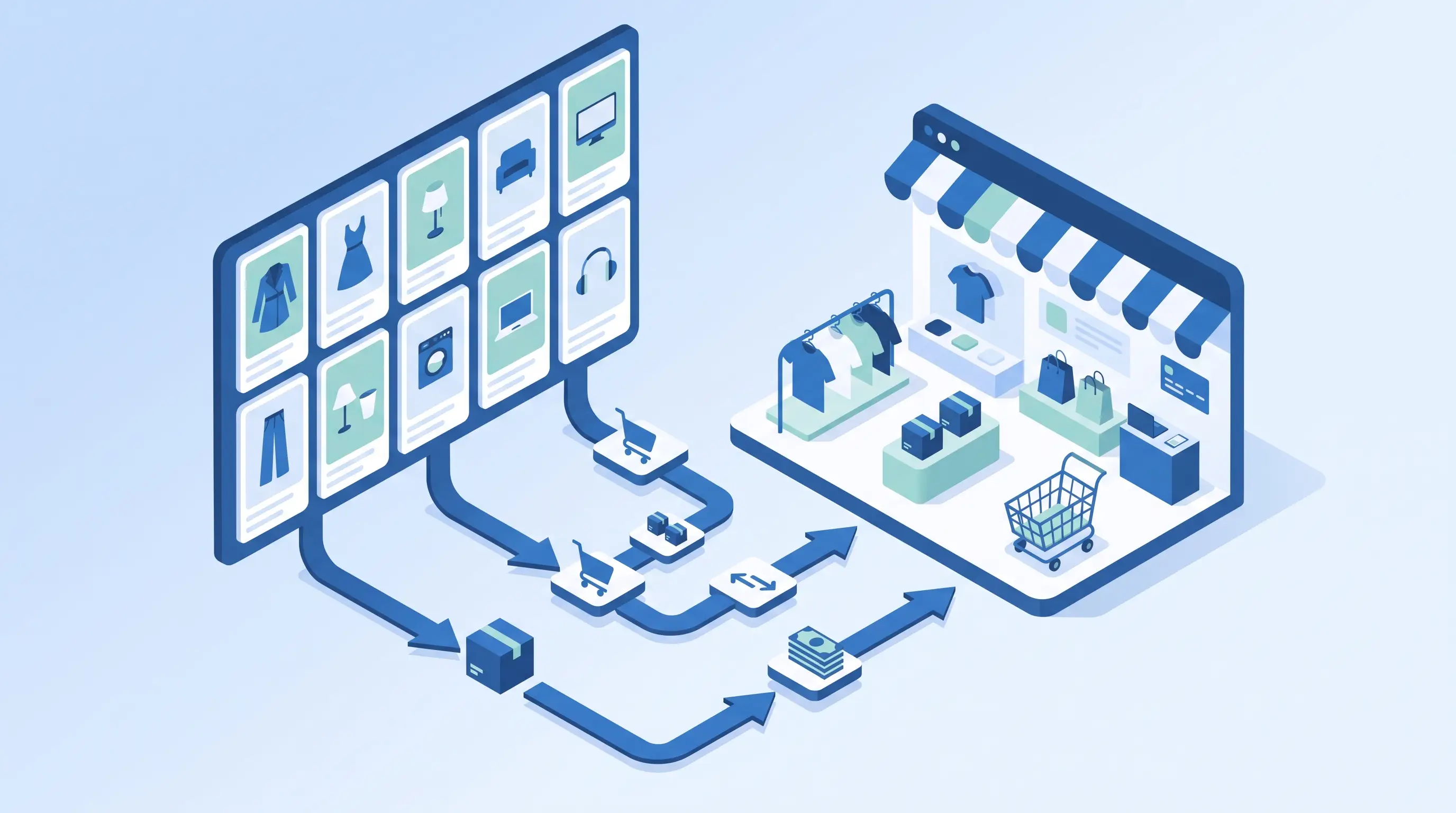

There are two fundamental ways to sell on TikTok: organic content that leans on the algorithm's discovery power, and TikTok ads that scale that content. On the organic side, follower count is not a prerequisite; a product video with a genuine hook–value–CTA structure can reach hundreds of thousands of people from a zero-follower account. On the ad side, TikTok Ads — and especially Spark Ads, which turns organic video into paid promotion — carry proven content to target audiences at scale. Sales come from building these two layers together and directing traffic to a properly tracked site.
As of 2026, TikTok in Turkey has moved well beyond being purely an entertainment platform; users open the app to discover products, research prices, and watch real usage videos before they buy. The same question appears in the comments every day: "Where can I get this?" In this guide, drawing on experience from the brands we manage, we'll walk through the system that turns that question into a sale for your product — step by step: organic content structure first, then the ad side, and finally the local realities of commerce in Turkey and measurement.
Can You Really Sell on TikTok? The Algorithm's Discovery Power
What sets TikTok apart from other social platforms is that content distribution is based on interest signals, not on follower lists. On Instagram, a post is shown to your followers first and spreads based on the engagement it receives from them; on TikTok, every video — regardless of account size — is presented to a small test audience first. If the signals are strong (watch time, rewatch rate, likes, comments, shares, and profile visits), the video moves to the next, larger pool. As this cycle repeats, reach grows exponentially.
This mechanism has two critical implications for businesses:
- The barrier to entry is low. You don't need to spend years building a following; even your first few well-structured videos can reach potential customers. A business account opened yesterday can outperform a competitor's decade-old account — something that's nearly impossible on Instagram but happens on TikTok every day.
- Every video sits its own exam. The algorithm evaluates content individually; yesterday's viral video doesn't guarantee reach for today's. That's why selling on TikTok requires not a one-off lucky break but a sustainable content system.
The path to sales follows from this: video is watched → profile is visited → link in bio is clicked → purchase is made on-site (or an order is placed via DM). The buying decision is usually made not inside the video but afterwards; so a video's sole job isn't to sell — it's to move the viewer to the next step. Keeping this chain in mind when producing content is the first and most important mindset shift for selling on TikTok.
The Core of Organic Sales: The Hook–Value–CTA Structure
When we analyse the videos that drive sales across the accounts we manage as part of our social media management service, we invariably see the same three layers: a hook that stops the viewer, a value section that keeps them watching, and a CTA (call to action) that shows them the next step. Videos produced without this structure either barely get watched or get watched but don't convert to sales.
Hook: The First 1–3 Seconds
A user's thumb is ready to scroll at any moment; the first seconds of your video have to stop that reflex. Some hook patterns that work:
- Curiosity-provoking claim: "We pack this product 3,000 times a month, and here's why..."
- Mistake/warning pattern: "If you're not checking this detail when buying skincare products, you're wasting your money."
- Visual satisfaction: Opening with the most striking moment of the product — pouring wax, cutting soap, unboxing.
- Opening with a question: "If you brew coffee at home, are you making this mistake too?"
What to avoid is equally clear: logo animations, lengthy greetings, corporate intros along the lines of "today we're going to introduce you to our product." These get scrolled past in the first second and feed a negative signal back to the algorithm.
Value: The Section That Keeps Viewers Watching
The hook stops the viewer; value generates watch time — the signal the algorithm cares about most. Value can be delivered in three forms: information (teaching viewers about the problem your product solves), entertainment (humour, storytelling, character), and satisfaction (packaging, production, transformation footage). The key is not to put the product in a shop window but to embed it in a context. A video that says "We shipped 47 parcels today — let me show you the best-seller" gets far more views than a studio shoot of the same product. There's also the one-message rule: a video trying to communicate three features communicates none of them. One idea, one product, one angle per video.
CTA: Showing the Next Step
If there are views but no sales, the problem is almost always a missing CTA. On TikTok, a CTA doesn't have to be aggressive; one natural sentence woven into the flow is enough: "Details at the link in my profile," "Which colour should I bring? Write it in the comments," "Follow so you don't miss the next one." A comment CTA grows engagement, a link CTA drives traffic, a follow CTA builds a lasting audience — distribute all three across your videos. If you're not telling viewers what to do at the end of every video, you're leaving the job of turning views into revenue up to chance.
TikTok Content Formats That Drive Sales
A single viral video is luck; a sales system comes from format diversity. The following formats deliver the most consistent results on product-selling accounts:
Order Preparation and Packaging
Packaging videos that open with something like "I'm packing an order going from Kayseri to İzmir" are one of TikTok's most powerful sales formats. They deliver both satisfying footage and social proof: viewers see with their own eyes that other people are genuinely placing orders. Voiceover, natural ambient sound, or a calm ASMR-style recording — all three work; what matters is that it can be produced regularly.
Before / After and Real Usage
In categories like cleaning products, cosmetics, textiles, and home goods, videos showing transformation directly influence buying decisions. The critical point here is honesty: exaggerated or filtered results may rack up views in the short term, but they backfire in the comments and permanently erode brand trust.
Behind the Scenes and the Production Story
Show your workshop, your production process, even the moment you sort out defective items. The emphasis on handcraft and domestic production is a powerful purchasing motivator in Turkey; the feeling that "there are real people behind this product" can even soften price objections. And you don't need to script anything new for this format — simply filming what you already do every day is enough.
Q&A and Handling Objections
The feature that lets you reply to comments with a video is one of the easiest ways to produce sales content. Response videos to real questions like "How long does shipping take?", "Will it suit my skin type?", "Why this price?" generate new content and pre-emptively convince the hundreds of people who were going to ask the same thing. This format — which chips away at sales objections one by one — consistently produces among the highest conversion rates of any content type.
Series Content
Ongoing series like "Setting up a candle workshop: Day 1" or "The 5 most interesting orders this month" noticeably increase profile visits and follow rates — building a lasting audience beyond any single video. A series viewer is the segment that forms an emotional connection with a brand fastest and converts to buyer most easily, because they know you not from a single video but from inside a story.
Not Looking Like an Ad: The Power of Natural Content
TikTok users can smell an ad and scroll past it. The platform's unwritten first rule is: your content must look like it belongs on the platform. One of the clearest patterns we observe across the accounts we manage is this: polished corporate videos shot in a studio with professional equipment consistently lag behind candid, naturally lit videos shot on a phone. This isn't praise for low quality — it's recognition that fitting the platform's language is rewarded.

Practical principles for content that feels natural:
- Shoot vertically and on your phone. A horizontal video cropped to vertical with blurred edges sends an "I don't belong here" message from the very start.
- Speak in first person. Conversational language — as if explaining something to a customer — not a presenter's tone. A regional accent or everyday expressions are not flaws; they're signals of authenticity.
- Use subtitles and on-screen text. A significant share of viewers watch without sound; videos without text support lose this audience entirely.
- Use trending sounds sparingly. A trending sound can boost reach, but anchoring every video to a trend erases your brand identity. In narrated videos, your own voice is always more powerful.
- Don't hide imperfections. A product that drops, a ruined take, a fit of laughter — these can be the most-watched moments of a video. Imperfect content builds viewer trust.
Driving Traffic from TikTok to Your Site and Measuring Sales
Views alone are not revenue; the bridge between them is your profile and your site. Prepare your profile for sales first: your bio should state in one sentence what you sell, include location/shipping info, and feature a clickable site link; pin the 2–3 videos that drive the most sales to your profile. A visitor who lands on your profile but can't figure out what you sell in 5 seconds will leave.
On the measurement side, three tools work together. First, UTM parameters added to your bio link: this lets you see TikTok traffic and its conversions separately in GA4; see our GA4 guide for setup details. Second, the TikTok Pixel installed on your site: when you move to running ads, it reports add-to-cart and purchase events back to the platform; conversion optimisation doesn't work without the pixel. Third, brand search tracking: a significant portion of TikTok users don't click the link — they search your brand name on Google or Trendyol instead. Across the accounts we manage, we often read the impact of a viral video not from link clicks but from the surge in brand searches and direct traffic in the days that follow. Don't squeeze TikTok's sales impact into a single click report.
The final link in the chain is your site itself: TikTok traffic is almost entirely mobile and impatient. A slow-loading, hard-to-navigate mobile site turns this traffic into waste. For tactics on converting site visitors into buyers, our conversion rate (CRO) guide is the natural next read.
TikTok Ads: Basic Campaign Setup
Organic content is the system's engine; ads are the gear that multiplies its power. The conceptual steps to getting started with TikTok advertising work like this:
- Open a TikTok Ads Manager account. Create an ad account with your business details and set up billing and payment. This account operates separately from your personal TikTok account.
- Install the Pixel and verify events. Modern e-commerce platforms like ikas and Shopify have built-in TikTok integrations; test that page view, add-to-cart, and purchase events are flowing correctly before spending money on ads.
- Choose your campaign objective consciously. A "views" or "traffic" objective may look attractive on a small budget, but if you're looking for sales your real target is conversion/sales campaigns. It's normal for results to fluctuate in the first few weeks while the system learns, since there isn't enough conversion data yet.
- Keep targeting broad. TikTok's algorithm is generally better at finding the right people than narrow interest targeting is. Setting basic constraints like country, age range, and gender and leaving the rest to the creative is the healthiest starting point for most SMEs.
- Build the budget on a testing mindset. In the Turkish market, you can run technical tests with a few hundred TL per day; but for meaningful learning and sales data, the sectorally accepted approach is to start from a few thousand TL per month and gradually increase the budget as the winning creative becomes clear. The exact figure depends on product, margin, and competition; the first month should be seen as a "data month," not a "profit month."
- Invest in a creative set, not a single video. Test 3–5 different hooks and formats for the same product; shift the budget to the winning video. Ad fatigue on TikTok is fast — even a winning creative needs refreshing within a few weeks.
The core metric you'll use to evaluate ad returns is ROAS; we explained the calculation logic in detail in our ROAS guide. If you have advertising experience on Meta, the logic will feel familiar; for a comparison of budget and creative approaches across the two platforms, also check our Meta Ads guide. The broad summary: Meta has more developed targeting and remarketing muscles; on TikTok, the reach cost — when the right creative combines with its organic effect — is often more advantageous.
Spark Ads: Turning Organic Content into an Ad
Spark Ads is the most valuable TikTok advertising feature for SMEs: instead of producing a brand-new ad video from scratch, you run an organic video that's already live on your account (or a creator's account with their permission) as a paid ad. The video appears in the feed like a normal post; the profile remains clickable, and likes and comments continue to accumulate on the real post.

Spark Ads' advantages over standard ads:
- Social proof is preserved. A viewer seeing the ad sees the real comments and likes beneath the video; a comment saying "I bought this, it's amazing" is more persuasive than the best ad copy.
- You start with proven content. Because you're scaling a video that already performed well organically, the risk of burning ad budget on untested creative is reduced.
- The ad also grows the account. Follows and engagement from the ad are permanent; in standard ads, this accumulation disappears.
- It scales creator collaborations. You can run a creator's video about your product — with their authorisation — from your own ad account; the voice stays natural, the distribution stays in your control.
The process is conceptually straightforward: the video owner grants ad permission for the post and shares the resulting code with you; you then link this video to your campaign in Ads Manager (interface steps may change over time, the logic stays the same). Let organic data decide which video to choose: videos with above-average watch times and comments piling up with buying signals like "what's the price, where can I get it" are the strongest candidates for Spark Ads.
| Criterion | Organic Content | Spark Ads | Standard Ads |
|---|---|---|---|
| Cost | Time and effort | Ad budget | Ad + production |
| Speed of results | Weeks/months | Days | Days |
| Social proof | Builds naturally | Preserved and grows | Disappears with campaign |
| Best suited for | Building the system, building trust | Scaling a proven video | Campaign/offer announcements |
TikTok Commerce in Turkey: Current Realities
Although the in-app shopping feature TikTok Shop is spreading rapidly worldwide, as of the time this article was written, its scope in Turkey is not fully settled or stable; in-platform commerce features roll out at different speeds in different countries, and the terms can change. It's worth verifying the current situation through TikTok's official channels. Our recommendation is clear: build your sales structure around driving traffic to your own site rather than relying on an in-platform store; if TikTok Shop becomes fully active in Turkey, you can add it as an extra shelf. Your own site is the only channel where customer data, margins, and remarketing power belong to you.
If you don't yet have an e-commerce site, our e-commerce site launch guide covers the full process. When converting TikTok traffic into sales in Turkey, these are the local realities that need to be on the table:
- Payment infrastructure: Offering instalment options through iyzico, PayTR, or a bank virtual POS (payment gateway) directly affects conversion, especially on mid-to-high cart values.
- Shipping and desi (volumetric weight): A viral video can bring in hundreds of orders overnight; if your shipping agreement, desi costs, and inventory plan aren't ready for that scenario, the viral moment turns into a wave of returns and complaints.
- Tax and documentation: VAT, e-invoice/e-archive, and distance sales agreement obligations apply to all sales, including orders taken via DM.
- KVKK: Names, addresses, and phone numbers collected via DM or comments are personal data; your disclosure notice and data storage practices must cover this channel too.
There's also an indirect but powerful effect: some users who see your product on TikTok will search for you on Trendyol or Hepsiburada. If your marketplace presence is strong, TikTok's organic impact comes back as sales there too; so set up your channels not as rivals but as shelves that feed each other.
Who Is TikTok Sales Right For — and Who Isn't?
Let's be honest: TikTok isn't the right channel for every business. Suitability depends largely on how visually demonstrable your product is and your capacity to produce content consistently.
- Strong candidates: B2C products that can be shown visually (cosmetics, textiles, home and lifestyle, food, jewellery, hobby products), workshop and manufacturing brands with a production story, products in a price range suited to impulse purchases, and service providers looking to grow a personal brand (trainers, nutritionists, lawyers and similar — here the "sale" is a consultancy appointment).
- Profiles that will struggle: Those selling to a narrow, niche B2B segment; high-budget projects where the buying decision takes months; and businesses that can allocate neither the time nor a team to regular video production. For these profiles, the same budget typically performs more efficiently in Google Ads or SEO.
If you're undecided, two resources will make things easier: if you want to put Instagram alongside — or instead of — TikTok, our Instagram and Facebook advertising guide covers that; if you're curious about the agency-managed side of things, see our social media management guide. To see which channel deserves priority for your business, our free analysis wizard will build a roadmap in a few minutes.
First 30 Days: A Workable Launch Plan
To turn theory into a system, split the first month into a four-week plan:
- Week 1 — Foundations: Open a business account, set up the bio and site link (with UTMs), study 10–15 accounts in your sector and note down the formats that work. Install the Pixel.
- Week 2 — Production rhythm: Film and publish at least 5 videos using the hook–value–CTA structure; be sure to try packaging, real usage, and Q&A formats. Don't wait for perfection — build the rhythm.
- Week 3 — Reading and filtering: Look at watch time and profile visit data; identify the 1–2 formats that are working and concentrate production on those. Turn questions from comments into new video topics.
- Week 4 — First ad test: Scale the top-performing organic video with a small-budget Spark Ads campaign; in GA4, read TikTok traffic's on-site behaviour and first conversions.
Expectation management is part of the plan: low and fluctuating views in the first few weeks are normal. Across the accounts we manage, we typically see a meaningful sales signal emerge around the 2nd or 3rd month of consistent posting; TikTok is a channel that grows stronger the more consistently you work it — like a muscle.
Running this system on your own — content calendar, filming, editing, comment management, ad optimisation, and measurement — doesn't fit into the day of most business owners; the most common sticking point isn't ideas but consistency. As Alis Dijital, in our social media management service we take on content structure, production rhythm, and ad management for all channels including TikTok under one roof, measuring success not by likes but by sales. If you'd like to assess the channel's potential for your business together, we're just a message away.