"How much does it cost to launch an e-commerce store?" — answering this question is more complex than you might think. Because the real cost is not just the store setup; payment commissions, shipping, advertising, and day-to-day operations account for the vast majority of your total first-year spend. For a new store, the right starting question is not "how much is the site?" but "how much will I spend in total in the first year, and when will I see a return?"
In this guide, we transparently examine every cost item involved in building an e-commerce business in Turkey as of 2026. The figures were compiled from 10+ Turkish web design and e-commerce sources, ikas/PayTR/iyzico official pricing, and up-to-date data such as the TÜRMOB 2026 accounting fee schedule. We present example budgets for three different scales (micro, small, growth) and surface the often-overlooked "invisible costs."
1. The Wrong Question: "How Much Is the Site?" vs. "What Will It Really Cost?"
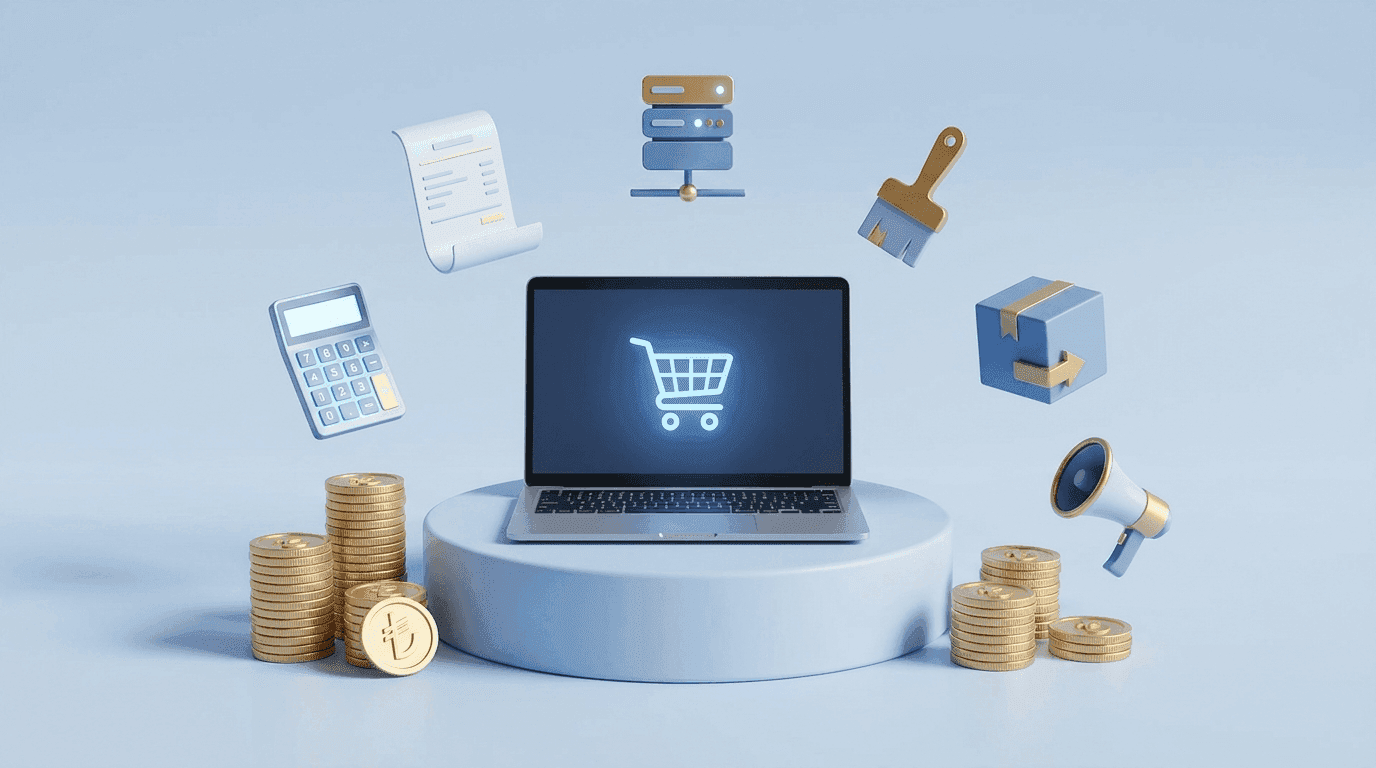
The question "how much is the site?" asks about only one part of e-commerce. Your real starting budget falls under four main groups:
- Technology and platform: platform subscription, domain, SSL, corporate email, design, plugins.
- Legal and operational setup: company formation, e-invoice, distance selling agreement, KVKK (Turkish data protection law), accountant/bookkeeper.
- Transaction costs: virtual POS (payment gateway) commission, instalment financing charges, shipping, packaging.
- Marketing and growth: initial ad budget, content production, product photography, email automation.
Counting only the first of these four as "setup cost" and overlooking the others is the primary cause of major financial surprises in the first 3–6 months.
2. Platform: Not a One-Off, but a Monthly Decision
Your e-commerce platform is its operating system. There are three common options in Turkey:
- ikas (local SaaS): built specifically for the Turkish market; virtual POS (payment gateway), shipping, and marketplace integrations are ready out of the box. Monthly fees vary by store size; you can review our ikas packages. Typical annual platform costs range from approximately ₺6,000–15,000 for small stores to approximately ₺25,000–60,000 for growing stores.
- Shopify (global SaaS): a vast app ecosystem; however, Turkey-specific integrations generally require additional apps and costs. For a detailed comparison, see our ikas vs. Shopify guide.
- Open source / custom software: WooCommerce, Magento, or fully custom development. No monthly subscription, but hosting, maintenance, and development costs apply.
Annual payment plans are generally 15–20% cheaper than monthly billing. For large-scale stores (enterprise B2B or high-traffic brands), the platform can cost ₺50,000–150,000 per year.
3. Domain, SSL, and Corporate Email
A domain (web address) is your brand's identity on the internet. Typical pricing:
- .com domain — approximately ₺300–500/year
- .com.tr domain — approximately ₺400–600/year (trade registry certificate required)
- SSL certificate — free on modern platforms (Let's Encrypt or provided by the platform)
- Corporate email (info@yourbrand.com) — Google Workspace approximately ₺200–280/user/month; Zoho has free alternatives
Choosing a domain is a decision that is hard to reverse; when making your choice, we recommend checking alternatives with our domain search tool and doing a quick domain research first. For more, see our corporate email guide.
4. Design: Pre-Built Theme or Custom Design?
Design budgets vary according to the maturity stage of your store. Real price ranges in the Turkish market for 2026:
- Free pre-built theme: 0 TL — most platforms come with 5–10 free themes. Usable for a start, but won't differentiate you from competitors.
- Premium pre-built theme (with customisation): ₺5,000–15,000 one-time. A sensible middle ground; colour, font, and homepage layout adjustments are made on top of the existing theme.
- Custom e-commerce design (brand-specific): ₺25,000–80,000 — market average. Brand-specific homepage, product page, category page, cart, and checkout design; Figma design + theme coding included.
- Enterprise / B2B / custom software e-commerce: ₺80,000–200,000+ — for brands with needs such as high traffic, multi-language, multi-currency, ERP integration, and custom customer portals.
The "start with a pre-built theme, switch to custom design once sales come in" approach is the right call for most new stores. When diving deeper into the topic, our pre-built theme vs. custom design guide is useful. For professional services, see our ikas design service and custom software service.
5. Legal Items: Things You Cannot Afford to Ignore
E-commerce is a business activity with tax and legal obligations. Items not to be skipped as of 2026:
- Sole proprietorship formation: ₺5,000–14,000 one-time (including notary, tax office registration, ledger certification, and accountant service fee). Home-office setups can stay at the lower end.
- Monthly accountant/bookkeeper: ₺3,500–6,000/month — the TÜRMOB 2026 minimum schedule for sole proprietorships is ₺3,593/month. Increases with transaction volume and business type.
- E-invoice / e-archive: ₺2,500–5,000/year (including integration and usage)
- Distance selling agreement, privacy policy, and return policy: ₺4,000–8,000 with legal consultancy, or low cost with a ready-made template
- KVKK (data protection) compliance: a disclosure text and data policy are mandatory; ₺3,000–6,000 with legal support for small stores
Postponing legal items can result in serious fines in later months from the Ministry of Commerce or data protection authority inspections. Set your accountant from day one.
6. Virtual POS Commissions and Instalment Financing Charges
Payment commissions are the most frequently underestimated cost item in e-commerce. Typical ranges for 2026:
- Single-payment transaction (PSP commission): 1.5% – 4.0% (PayTR next-day settlement approx. 1.79%, iyzico corporate entry approx. 3.99%)
- Single-payment, delayed settlement (30 days): approx. 0.59% (PayTR) — lower commission in exchange for funds reaching your account 30 days later
- Monthly fixed fee: none with most providers; ₺200–500 with some
Instalment Financing Charge (Seller's Cost — 2026 Typical Schedule):
| Number of Instalments | Financing Charge Paid by Seller (approx.) |
|---|---|
| 2 Instalments | approx. 7.53% |
| 3 Instalments | approx. 9.57% |
| 4 Instalments | approx. 11.60% |
| 5 Instalments | approx. 13.65% |
| 6 Instalments | approx. 15.68% |
| 7 Instalments | approx. 17.71% |
| 8 Instalments | approx. 19.75% |
| 9 Instalments | approx. 21.80% |
| 10 Instalments | approx. 23.82% |
| 11 Instalments | approx. 25.86% |
| 12 Instalments | approx. 27.90% |
The rates above are averages of typical 2026 instalment schedules for bank cards (advantage, axess, bonus, cardfinans, bankkart, maximum, paraf, world, etc.). May vary by provider and card; lower rates are possible under special agreements.
Important note: the common practice in Turkey is for the seller to absorb the instalment financing charge — because offering instalments increases conversions by 30–50%. The customer chooses instalments but pays no extra; the difference comes out of the seller's pocket. For this reason, instalment financing charges must be treated as a fixed cost when calculating profit margins.
A store operating at an average PSP commission of 3% plus an average instalment financing charge of 15% pays approximately ₺6,000–18,000 TL in payment costs per month on 200,000 TL in monthly revenue. The right provider and the right deal make a significant difference. You can run a concrete comparison for your store on our virtual POS commission calculator page. For a detailed analysis, also see our virtual POS comparison guide and our article on ikas's commission structure.
7. Shipping: Both a Cost and a Conversion Factor
Shipping directly affects whether a customer answers "will I buy from this store?" on the customer side. On the cost side:
- Average shipping cost per desi (volumetric weight) is ₺30–65 (varies by annual agreement)
- Shipping agreements can be made at 100+ shipments per month — discounts of 30–50% are possible
- Packaging materials: box, filling, label — approximately ₺5–12 per shipment
Use our desi (volumetric weight) calculator to calculate the actual desi of your products; an incorrect desi causes both pricing errors and disputes with the shipping carrier. Similarly, our shipping cost calculator helps you set the right free-shipping threshold.
8. Products and Inventory: Where Capital Gets Tied Up
Inventory appears as an "asset" on the balance sheet but is the most cash-flow-constraining item. Two fundamental strategies for beginners:
- Dropshipping (stockless sales): no inventory risk, low margins, quality control is difficult
- Low stock + fast replenishment: holding 1–2 weeks of stock and replenishing quickly — the healthiest middle ground
Rather than stocking your entire product portfolio at the start, beginning with a small test inventory and growing from the products that sell protects your cash flow. Our market analysis guide can help you decide which products to stock.
9. Ad Budget: The Key to Your First Sales
A new store, no matter how good it is, will struggle to make sales without advertising. Advertising is the most reliable way to accelerate sales. Typical monthly ad budgets compiled from 2026 industry research and our real client operations:
- Launch / testing phase: minimum ₺20,000–30,000/month. Below this threshold the campaign learning process cannot complete; the algorithm cannot collect enough data.
- Small store (growth): ₺30,000–60,000/month. Google + Meta used together; at least 500–1,500 TL per day per platform.
- Mid-scale (institutionalisation): ₺80,000–200,000/month. Multi-channel, segmented, seasonal campaigns.
- Large scale: ₺200,000+/month. Brand campaigns + performance + influencer + TikTok included.
In the first 1–2 months, 70–80% of advertising is "learning budget" — you learn which creative, which audience, and which message works. That is why the first month's ROAS will be low, and that is normal. Using Google Ads and Meta Ads together produces a healthier conversion rate. Use our break-even ROAS calculator to set your target ROAS.
General rule: Monthly ad budget should be 15–30% of target monthly revenue. If you are targeting ₺200,000 in revenue, you need a ₺30,000–60,000 ad budget.
10. Operations: Not Money, but Time Cost
A one-person e-commerce operation can easily require 80–120 hours a month: order fulfilment, customer service, content production, procurement, and accounting follow-up. Convert this time to its monetary value (100 hours at ₺250/hour = ₺25,000). The operation you thought was "free" is actually the largest hidden item on your balance sheet.
As the store grows — 100+ orders per month — it makes sense to hand off operations to a part-time assistant. This adds an operations cost but frees your time for the strategy and marketing that will grow revenue. A full-time operations employee in 2026 is at the ₺30,000–45,000/month gross level.
11. Three Example Budget Scenarios (Annual Total — Average Values)
All figures in the table below are market averages for 2026; they can deviate by 30–50% depending on your store's sector, margins, target scale, and location. Your goal is to identify a minimum viable starting point.
| Line Item | Micro (test) | Small (growth) | Growing (institutionalisation) |
|---|---|---|---|
| Platform (annual subscription + apps) | ~₺8,000 | ~₺18,000 | ~₺45,000 |
| Domain + email | ~₺1,500 | ~₺2,500 | ~₺4,000 |
| Design (one-time) | ~₺5,000 (pre-built theme) | ~₺40,000 (custom design) | ~₺120,000 (enterprise + UX) |
| Legal + accountant (annual) | ~₺55,000 | ~₺75,000 | ~₺120,000 |
| Initial inventory / products | ~₺25,000 | ~₺120,000 | ~₺400,000 |
| Product photography + content | ~₺5,000 | ~₺20,000 | ~₺80,000 |
| Advertising (12 months) | ~₺240,000 (₺20K × 12) | ~₺480,000 (₺40K × 12) | ~₺1,500,000 (₺125K × 12) |
| Operations (time + materials + assistant) | ~₺15,000 | ~₺60,000 | ~₺300,000 |
| POS commissions + shipping (annual) | ~₺30,000 | ~₺120,000 | ~₺500,000 |
| ANNUAL TOTAL | ~₺385,000 | ~₺935,000 | ~₺3,070,000 |
* All figures in the table are 2026 market averages. They can deviate 30–50% upward or downward depending on sector (fashion, cosmetics, electronics, food), brand positioning, location (Istanbul vs. Anatolia), and mode of operation. For a real budget plan, you can request a free digital analysis to produce figures specific to your store.
12. Invisible Costs: What Not to Miss When Budgeting
- Return shipping and return processing: typical return rate is 5–15%; each return incurs shipping + handling costs
- Bank reconciliation variance: a 0.1–0.3% gap can occur between the stated POS commission and the actual deduction
- Seasonal inventory loss: especially in fashion, old-season collections lose value
- Fraudulent orders and chargebacks: 0.3–1% risk; card reversals are processed by the bank
- Ad platform VAT: you pay VAT separately on Meta and Google ad spend, and work with your accountant to reclaim it
- Instalment financing charge invisibility: when the customer selects 6 instalments, your store pays approximately 15–16% financing charge; this item is generally left out of calculations
Adding a 5–10% "contingency buffer" to your annual budget for these items is a good rule to avoid surprises.
13. Tools for Calculating Costs Accurately
Our free calculation tools for your e-commerce decisions:
- Profit Margin Calculator — calculates net profit and margin per product
- VAT Calculator — converts prices between VAT-inclusive and VAT-exclusive
- Desi (Volumetric Weight) Calculator — calculates shipping desi accurately
- Shipping Cost Calculator — helps set your free-shipping threshold
- Customs Duty Calculator — for imported products
- Break-Even ROAS Calculator — sharpens your ad targets
4 Book Recommendations for E-Commerce Cost and Financial Management
- Profit First — Mike Michalowicz. Set aside profit first, then spend; a paradigm-shifting financial approach for small businesses.
- The E-Myth Revisited — Michael Gerber. A classic on systematising small business operations.
- Crossing the Chasm — Geoffrey Moore. For planning your marketing budget according to your growth stage.
- Lean Startup — Eric Ries. Test with minimum budget, learn, iterate — a practical guide for new stores.
One Piece of Advice for Getting the Budget Right
Before deciding "how much will I spend?", clearly answer the question "how much do I aim to earn in the first year?" Once your target revenue, profit margin, and target ROAS are set, the budget emerges on its own. The opposite approach — "this is how much I have, what can I do?" — almost always ends in overspending and underperformance.
When Does Professional Support Make Sense?
Which platform to choose, which payment provider to work with, how to allocate your initial ad budget — these decisions cumulatively determine whether your first year is a loss or a profit. A wrong platform decision leads to "why did we spend so much and see no return?" twelve months later; the right setup delivers 2–3 times faster growth on the same budget.
At Alis Dijital, within our e-commerce consultancy service, we prepare a customised road map based on your budget and targets, and plan every item together from platform to advertising strategy. If you want to move forward with ikas, see our ikas packages; if you are migrating from an existing platform, see our migration to ikas page. By requesting a free digital analysis, we can work through an estimated budget plan specific to your situation together.